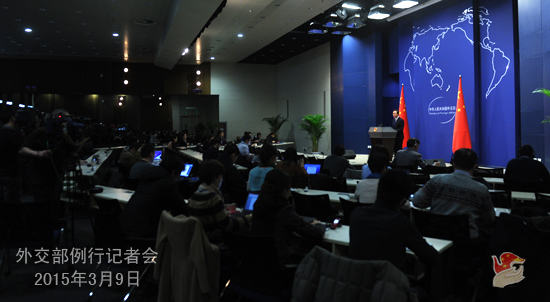
Q: Foreign Minister Wang Yi said yesterday that China and Canada have reached agreement on issuing visas to each other's citizens with a validity period of up to 10 years which will come into effect today. Can you give us more details?
A: Upon friendly consultation and in the principle of equality and reciprocity, an agreement on issuing long-validity and multiple-entry visas to each other's citizens traveling for business, tourism or family purposes has been reached and verified through an exchange of notes between China and Canada. As per the agreement, starting from March 9, 2015, China and Canada will issue to each other's citizens traveling for business, tourism or family purposes multiple-entry visas with a validity period of up to 10 years within their passport validity. This arrangement is a major step forward towards the facilitation of people-to-people exchanges. It will further deepen exchanges and cooperation between China and Canada in various fields, move forward China-Canada strategic partnership, and deliver benefits to the two peoples.
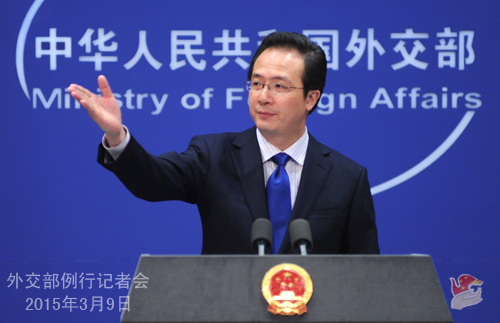
Q: On March 4, a Turkish Airlines flight veered off the runway in the course of landing in Kathmandu, Nepal. The airport was closed consequently and several thousand Chinese passengers were trapped. Can you provide any update on this? What measures have been taken so far?
A: As Foreign Minister Wang Yi said at yesterday's press conference, we are always concerned with the safety and wellbeing of every one of our compatriots, and we will do everything in our power to protect and assist them. After the airport was shut down on March 4, the Chinese embassy in Nepal immediately activated the emergency response mechanism, and coordinated with relevant departments of the Nepalese government and Nepalese airlines to ensure the safety and fundamental rights and interests of Chinese passengers and provide them with counseling, medical care and other services. After the airport was reopened on the night of March 7, Chinese embassy in Nepal worked with various airlines to send trapped Chinese passengers home in batches. At present, we are proceeding with relevant work orderly. We will do our best to ensure that all the Chinese citizens stranded in Nepal will come back home at an early date.
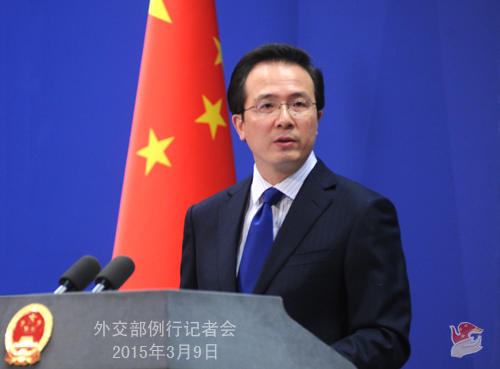
Q: Today, German Chancellor Angela Merkel said during a visit to Japan that Germany and the country that was invaded achieved reconciliation after the Second World War, not only because Germany did face its Nazi past squarely, but also because the country that was invaded showed generosity. Both France and Germany have made enormous contributions to their reconciliation after the Second World War. Do you believe that China and Japan should do the same?
A: Foreign Minister Wang Yi said at yesterday' press conference that the history issue has been haunting the China-Japan relationship. An elder Chinese diplomat once said that the more the victimizer is conscious of his guilt, the easier the victimized can recover from the suffering. After China claimed the victory of the Chinese people's war of resistance against Japanese aggression, it showed generosity to Japan, and has never blurred the distinction between a minority of militarists and the general public in Japan. The key is for Japan to show sincerity on the history issue and never turn a blind eye to history. This year marks the 70th anniversary of the victory of the world anti-Fascist war and the Chinese people's war of resistance against Japanese aggression. In this special year, we hope that Japanese leaders can make the right choice on the history issue.