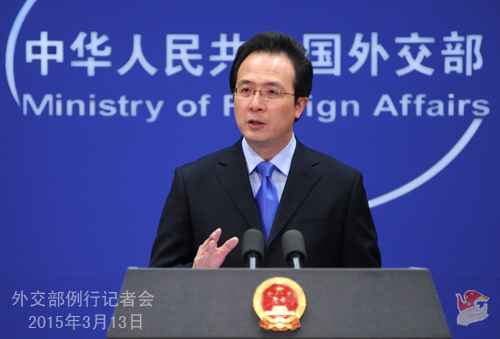
At the invitation of Foreign Minister Wang Yi, Foreign Minister Mahendra Bahadur Pandey of Nepal will pay an official visit to China from March 17 to 21.
This will be the first important visit between China and Nepal this year as well as part of the celebrations marking the 60th anniversary of the establishment of China-Nepal diplomatic relations. Both sides attach great importance to this visit, during which Chinese leaders will meet with Foreign Minister Pandey and Foreign Minister Wang Yi will hold talks with him.
Nepal is a friendly neighbor of China, and the traditional friendship and amicable cooperation between the two countries have been growing in the past six decades since the establishment of diplomatic relations. During a visit to Nepal at the end of last year, Foreign Minister Wang Yi proposed the nine major areas and three aspects of support of the practical cooperation between China and Nepal, and the Nepalese side responded positively to this. The nine areas include cooperation on economy and trade, investment, agriculture, infrastructure, science and technology, connectivity, tourism, people-to-people exchanges and culture as well as security and law enforcement. The three aspects involve support of finance, talent and local resources. Through this visit, we hope to exchange views on the high-level interactions and the practical cooperation between the two countries and push forward the traditional friendship and comprehensive cooperative partnership between China and Nepal.
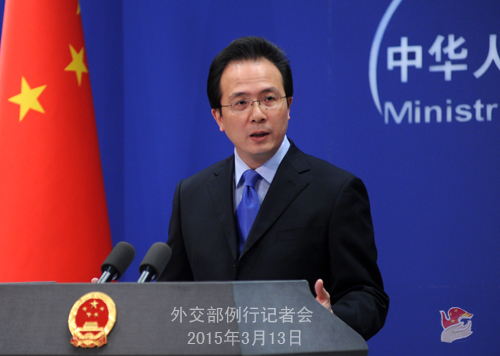
Q: On March 12, the UK officially applied to join the Asian Infrastructure Investment Bank (AIIB) as a prospective member. A spokesperson of the White House National Security Council responded that any new multilateral institution should incorporate high standards of the World Bank and regional development banks, and hoped that the UK will use its voice to push for AIIB's adoption of high standards. There are also reports saying that the US is persuading other countries not to join the AIIB. How does China comment on this?
A: On March 12, the UK submitted to China the confirmation letter of joining the AIIB as a prospective member and officially applied to participate in the AIIB. China welcomes UK's decision.
The AIIB will design its governance structure and operation policy following the principles of openness, inclusiveness, transparency, responsibility and fairness. It will learn from the good practices of the existing multilateral development banks, and meanwhile avoid the alike problems they have encountered to reduce the cost and operate more effectively. The AIIB will cooperate with and complement the existing multilateral development banks, better serve its member states and support the infrastructure building and economic development in Asia. This will also help relevant countries to benefit more from Asia, a region brimming with development vitality and potentials. Everyone is welcome to join us in this undertaking which is beneficial to all.
Q: How important is it to China that the UK joins the AIIB as an important western economy?
A: As I have said, we welcome UK's decision. As the chairman of the chief negotiators' meeting on the establishment of the AIIB, China is heeding opinions from the prospective members in accordance with multilateral procedures. If everything goes well, the UK will officially become a prospective member of the AIIB at the end of March, and its participation fully proves the openness and inclusiveness of the AIIB. The early establishment and operation of the AIIB will boost the infrastructure building in Asia, elevate Asia's economic development level and further advance the common development of Asian countries.
Q: There have been reports that after more than a decade of warfare, the Afghan peace talks could begin involving official negotiations between the Afghan government and the Taliban. China says that it supports the "Afghan-led and Afghan-owned" peace and reconciliation process. Why is China so concerned about peace and reconciliation in Afghanistan, and what Chinese interests are at stake? Are you optimistic about the talks?
A: Peace and stability of Afghanistan meets the common interests of the international community. As a friendly neighbor of Afghanistan, China highly values developing relations with Afghanistan, and hopes for enduring peace, stability and development in Afghanistan at an early date. We support the "Afghan-led and Afghan-owned" peace and reconciliation process, and are poised to make constructive efforts to this end.
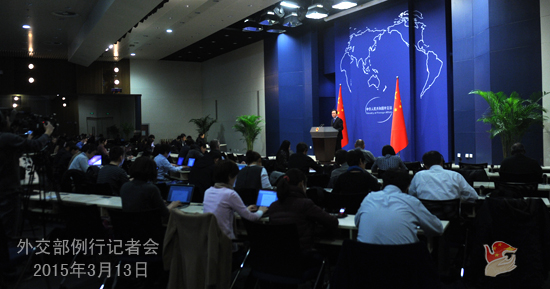
Q: The DPRK launched seven surface-to-air missiles to the eastern waters of the Peninsular yesterday. How does China comment on this?
A: We have taken note of relevant report. It is in the interests of all parties concerned to maintain peace and stability of the Korean Peninsula. Given the current situation, we hope that relevant parties can do more things that contribute to easing the tension and safeguarding regional peace and stability.
Q: Do you believe that countries like the ROK, Japan and Australia may be reconsidering their decisions of not joining the AIIB?
A: Up to now, many countries have reacted positively and showed great support to the building of the AIIB, aspiring to join the AIIB as a prospective member. The preparation is proceeding smoothly. As I have mentioned, the AIIB adopts the principle of openness and inclusiveness and any interested country is welcome to join in. This is good for Asian countries, and will also enable relevant countries to share the opportunities of Asia's development.