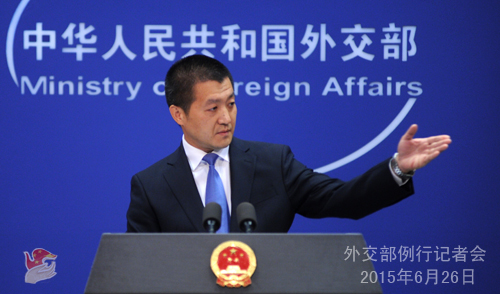
At the invitation of President Xi Jinping, President Tony Tan Keng Yam of the Republic of Singapore will pay a state visit to China from June 29 to July 4.
Q: The Dalai Lama will be visiting Britain next week and he is going to attend the Glastonbury Music Festival. What's China's comment on this?
A: I don't have information on the music festival you just mentioned. But I'd like to emphasize that our position on the Tibet-related issue is consistent and unequivocal. Tibet is an inalienable part of China. The Chinese side firmly opposes the provision of venues to the 14th Dalai Lama for his anti-China separatist activities by any country, organization or individual in whatever form.
Q: The International Conference on Nepal's Reconstruction was held in Kathmandu on June 25. Please brief us on China's participation at the conference. What assistance will China provide to Nepal?
A: The International Conference on Nepal's Reconstruction was held in Kathmandu on June 25. Foreign Minister Wang Yi attended the conference on behalf of the Chinese government. He met with Nepalese President Ram Yadav and Prime Minister Sushil Koirala and held talks with Nepalese Foreign Minister Mahendra Pandey on the sidelines of the conference.
The devastating earthquake on April 25 also inflicted heavy losses on China's Tibet Autonomous Region. While actively conducting rescue operations at home, we also provided immediate assistance to Nepal. The Chinese people will continue to stand with the Nepalese people in Nepal's post-quake reconstruction process.
At yesterday's conference, Foreign Minister Wang Yi announced on behalf of the Chinese government China's assistance package to support Nepal's reconstruction. It consists of five aspects: assistance in grants, support in loans, encouraging Chinese enterprises and organizations to expand investment in Nepal, helping Nepal with personnel training and pushing for deeper cooperation between Chinese localities and Nepal. China will support Nepal's reconstruction mainly in three areas, namely infrastructure, people's wellbeing and the capacity of disaster prevention and relief and relics preservation and repair.
China and Nepal are close brothers and partners with adjoining mountains and rivers. Nepal has always been friendly to China and has given China firm and consistent support on major issues concerning China's core interests. Now that our Nepalese brothers are in difficulties, we will not hesitate to lend a helping hand. In doing so, we are practicing the policy of upholding justice and pursuing shared interests proposed by President Xi Jinping, and the neighborhood diplomacy featuring amity, sincerity, mutual benefits and inclusiveness advocated by the Chinese government. I want to emphasize that in Nepal's post-quake reconstruction process, China will follow the principle that Nepal should play a leading role and its will be fully respected. We stand ready to strengthen coordination and cooperation with the international community. We hope Nepal would take the reconstruction process as an opportunity to step up economic and social transformation and upgrading so as to realize sustainable development.
Q: The Japanese government announced to hold next year's G7 Foreign Ministers' Meeting in Hiroshima, a city hit by an atomic bomb during WWII. According to the Japanese government, the aim is to call on the international community to uphold world peace and nuclear non-proliferation. What is China's comment on this?
A: We hope that the relevant party could present to the international community a thorough and accurate account of that unfortunate chapter of history. It will be beneficial to all parties, including Japan itself, if Japan could take the opportunity to give the international community a faithful and complete depiction of that part of history, adopt a correct outlook on history and commit itself to avoiding a repetition of the path of militarism and war.

Q: The US State Department released its Country Reports on Human Rights Practices for 2014. In the section relating to Hong Kong, it mentioned that protestors were beaten up by the police and that the suffrage of Hong Kong citizens was restricted. The report once again criticized China's human rights condition. What's your comment on that?
A: The US releases such kind of report year in and year out. Many of the contents are not in line with the real conditions. During relevant incidents in Hong Kong, the Hong Kong police took actions according to law, on which the central government and the government of the Hong Kong Special Administrative Region have reached a fair conclusion. The US side has also spoken positively on this during its contact with the Chinese side. I wonder on what basis the report was compiled. As to the voting on the universal suffrage bill by the Legislative Council of Hong Kong, the US has also made its stance clear in public. The views in the report are inconsistent with the positions the US has taken.
The Chinese people are in the best position to tell how the human rights condition is in China. The China section in this report is absurd as it is a mere repetition of subjective prejudice in disregard of the facts. We have already told the US side that we stand ready to conduct candid and constructive dialogues on the human rights issue with other countries in the spirit of mutual respect and equality. It is futile for any country to apply double standards and attempt to interfere in China's internal affairs under the pretext of human rights. We suggest the US take good care of its domestic affairs first and stop lecturing other countries on human rights.
I'd also like to add that, with the increase of people-to-people and cultural exchanges between China and the US in recent years, more and more ordinary US people are coming to China. They fully affirm the progress China has made in its social and economic development. Quite a few friends told me that the real situation in China is different from what they had heard at home. We hope the US would stop misleading its people and put more efforts into solving its own human rights problems, some of which have been there for a long time and heavily criticized.
Q: The Chinese government issued the Human Rights Record of the United States today. Why does China issue relevant report at this time every year?
A: On the issue of human rights, we stand for constructive dialogues among countries on the basis of mutual respect and equality. Unfortunately, the US has failed to stay committed to this. It is just a reciprocal approach taken by us in the spirit of fairness.
Q: First, what expectations does China have for the negotiation on the Iranian nuclear issue to be held in Vienna this weekend? Second, the Director of US National Intelligence Clapper said yesterday that China was the leading suspect in a massive hack that targeted Washington government files. Is there any reaction from China?
A: As for the first question, the negotiation on the Iranian nuclear issue has come to a final and critical point with the P5+1 and Iran accelerating their efforts to reach a comprehensive agreement. All parties have demonstrated strong political will, pragmatic attitude and innovative thinking. Important progress has been made, but there are still differences. A comprehensive agreement can be reached as scheduled, as long as all parties concerned work towards a common goal, properly accommodate each other's concerns and make timely political decisions with a sense of mission and historical responsibility.
The Chinese side will continue to play a constructive role in the final stage of the negotiation to push for an equitable, balanced and win-win agreement as scheduled as well as a comprehensive, durable and appropriate solution to the Iranian nuclear issue.
As for the second question, we have noted that although the investigation is still under way, China has been named as the suspect based on subjective suspicion. This is absurd, because as far as I know, the US exercises presumption of innocence instead of presumption of guilt.
