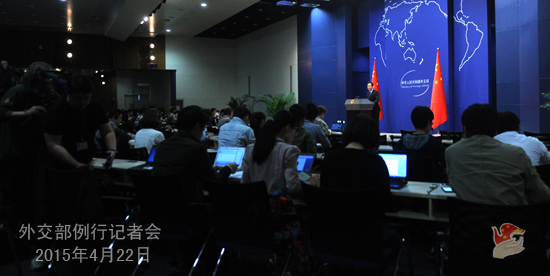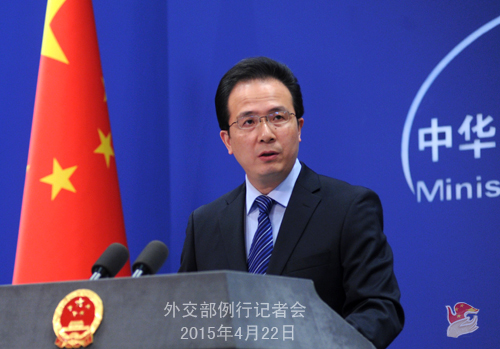
Q: The Defense Ministry of Saudi Arabia announced on April 21 that the "Decisive Storm" campaign launched by the coalition in Yemen has met its objectives. It would cease at midnight and be replaced by the operation code named "Renewal of Hope". What is China's stance on that?
A: The Chinese side welcomes the Saudi-led coalition's announcement of the cessation of the "Decisive Storm" campaign and the early restart of the political process in Yemen. It is hoped that all parties concerned would take concrete actions to implement relevant resolutions of the UN Security Council and initiatives of the Gulf Cooperation Council (GCC), resume negotiations as soon as possible, explore political solutions that conform to the realities of Yemen and accommodate the concerns of all parties, and bring national stability and lawful order back to Yemen at an early date.
Q: Reports say that the US State Department has recently urged the Chinese side to review its policy on the governance of Tibet and restart dialogues with the Dalai Lama or his representative with no preconditions attached. What is China's comment on that?
A: Tibet affairs fall totally within China's domestic affairs, and foreign countries have no right to interfere.
The Dalai Lama is not a pure religious figure, but a political exile who has long been engaged in activities aimed at splitting his homeland under the cloak of religion. If the Dalai Lama is sincere about having contact or negotiations with the central government of China, he should reflect upon what he has said and done and stop all separatist activities against China.
Q: Japanese Prime Minister Shinzo Abe expressed deep remorse over the Second World War at the Asian-African Summit today. How does China comment on that?
A: We have noted the relevant report. This year marks the 70th anniversary of the end of WWII. It is the prevailing view of the international community that Japan should face up to and reflect upon its history of aggression, so as to catalyze its reconciliation with Asian neighbors and win the trust of the international community. We hope that the Japanese side would answer the call for justice from the international community.
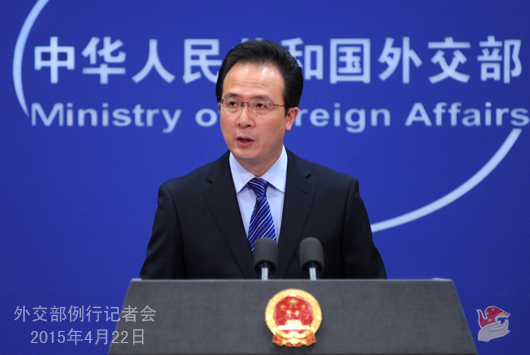
Q: First, the Philippine side denounced China's coast guard for turning water cannon on Philippine fishing boats in disputed waters. How does China respond? Second, the Japanese side expected President Xi Jinping and Japanese Prime Minister Shinzo Abe to meet on the sidelines of the Asian-African Summit in Indonesia. Is China also looking forward to the meeting? What topics will be on the agenda?
A: On your first question, the Huangyan Island is an inherent part of China. Chinese government vessels perform guard duty in waters off the Huangyan Island to maintain the normal order of these waters in accordance with the law. Recently, we have seen a large number of Philippine fishing boats lingering in the waters off the Huangyan Island with no permission from the Chinese side and disobeying China's management. That constitutes a violation of China's sovereignty and jurisdiction, impedes the performance of duty by Chinese government vessels and endangers the order and security of navigation in waters off the Huangyan Island. The Chinese side calls on the Philippine side to show earnest respect for China's territorial sovereignty, step up its regulation and education of the fishermen and stop all actions infringing upon China's territorial sovereignty, and rights and interests.
On your second question, I have no information to offer at the moment.
Q: This morning, over one hundred Japanese lawmakers paid homage to the Yasukuni Shrine for the annual spring festival. What is China's comment on that?
A: The Chinese side is firmly opposed to the visit by Japanese lawmakers to the Yasukuni Shrine. In such a sensitive year that marks the 70th anniversary of the end of WWII, political figures from Japan should uphold a right outlook on history, and do more to facilitate reconciliation and build up mutual trust with its Asian neighbors, rather than the opposite.