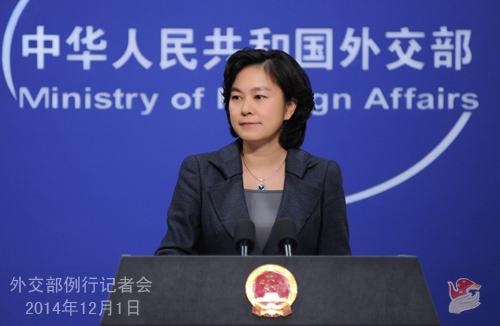
At the invitation of President Xi Jinping, President Michael D. Higgins of Ireland will pay a state visit to China from December 7 to 15.
Q: On the afternoon of November 28, a mosque in Kano of north Nigeria was hit by a suicide bomb attack, leaving at least 120 people dead and another 270 injured. What is China's comment on this?
A: The Chinese side strongly condemns and staunchly objects terrorism in all forms, and is deeply shocked and saddened by the heavy civilian casualties caused by this terrorist attack. We mourn for those victims and express our sympathy to the bereaved families and the injured. The Chinese side will continue to support the Nigerian government in safeguarding national security and stability.
Q: On November 30, Richard Ottaway who chairs the Foreign Affairs Committee of the lower house of the UK Parliament said he had been informed by the Chinese side that the Foreign Affairs Committee investigation group would be refused entry into Hong Kong. Ottaway said that "the Chinese government is acting in an overtly confrontational manner". How does China respond to this?
A: Hong Kong is a special administrative region of China, and Hong Kong affairs fall entirely within China's domestic affairs. China has on many occasions stated its opposition to the interference in Hong Kong affairs by any foreign government, institution or individual. With regard to the so-called "investigation" into Hong Kong by the Foreign Affairs Committee of the lower house of the British Parliament, the central government and Hong Kong SAR government of China have expressed firm objection to the British side several times and asked them to cancel their plan to visit Hong Kong. If individual member of the UK parliament insists on carrying out the plan, that would be what they call an overt confrontation, which will do no good to Sino-British relations.
Q: What are the laws and regulations that allow China to forbid the Foreign Affairs Committee of the lower house of the British Parliament to enter Hong Kong?
A: Hong Kong is a special administrative region of China, and the central government is in charge of the diplomatic affairs related to Hong Kong. The Chinese central government and the Hong Kong SAR government handle relevant issues in a lawful way. It is within China's sovereignty to decide who is allowed to enter China and who is not.
Q: Has the Sino-British relationship been or will it be damaged by the UK parliament members' attempt to investigate Hong Kong?
A: China holds a consistent and clear-cut position on developing relationship with other countries. We are willing to develop friendly and cooperative relations with other countries including the UK on the basis of mutual respect, equality and mutual benefit, and non-interference in each other's internal affairs. Meanwhile, we firmly object to any interference in China's internal affairs by any country in any form. China values relationship with the UK, and we are ready to continue developing our relationship with the UK following the principles of mutual respect, equality and mutual benefit, and non-interference in each other's internal affairs. This is in alignment with the common interests of the two countries and two peoples. China's door remains open to those who are wholeheartedly devoted to promoting friendship between China and the UK. But as for those who intend to interfere in China's domestic affairs, we strongly oppose and will never allow their attempt.
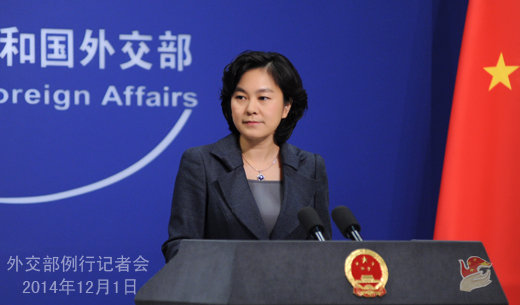
Q: How shall we understand the idea of major-country diplomacy put forward by President Xi Jinping at the Central Conference on Work Relating to Foreign Affairs? Is that a major change in China's diplomatic strategy and thinking?
A: The Central Conference on Work Relating to Foreign Affairs was held in Beijing on November 28 and 29. I suggest that you read closely the news release on the conference. This is an important conference held by the CPC Central Committee for a better performance in foreign-related affairs under the new circumstances. President Xi Jinping pointed out in his address that since the 18th CPC National Congress, the Central Party leadership, bearing in mind China's domestic and international interests, has maintained the continuity and consistency of China's foreign policy, taken the initiative to make overall planning and forged vigorously ahead. Notable progress has been achieved in China's foreign-related work.
President Xi Jinping underscored that China should develop a distinctive diplomatic approach befitting its role of a major country. What does that mean? I would like to draw your attention to the "six follows". In order to develop a major-country diplomacy with Chinese characteristics, and conduct diplomacy with a salient Chinese feature, Chinese style and a Chinese vision, we should follow the CPC's leadership and socialism with Chinese characteristics, and stick to our development path, social system, cultural traditions and values. We should follow the independent foreign policy of peace, always focus our strength on the development of the country and the nation, and stay on our own path of peaceful development. Meanwhile, we shall never relinquish our legitimate rights and interests, or give up China's core interests. We should follow the Five Principles of Peaceful Coexistence and practice democracy in international relations. We are firm in our position that all countries, regardless of their size, strength and wealth, are equal members of the international community and that the destiny of the world should be decided by people of all countries. We should uphold international justice and, in particular, speak up for developing countries. We should follow the mode of win-win cooperation, promote a new type of international relations featuring win-win cooperation, carry forward the win-win strategy of opening-up and apply the cooperative and win-win approach in every aspect of our external cooperation in political, economic, security, cultural and other fields. We should follow the right concept of morality and interests, attaching importance to both morality and interests. This means we should act in good faith, value friendship, champion justice and uphold morality. We should follow the principle of non-interference in other countries' internal affairs, respect the independent choice of development path and social system by people of other countries, promote peaceful resolution of differences and disputes between countries through dialogue and consultation, and oppose the willful use or threat of force.
Q: The trial destruction of chemical weapons deserted by Japan in the Ha'erba Ridge area of Dunhua city, Jilin Province started on November 30. What is China's comment on that?
A: The Xinhua news agency has released relevant information for your reference.
One of the grave crimes committed by the Japanese militarism in its war of aggression against China is having left a large amount of chemical weapons in China. Those chemical weapons abandoned by Japan in China 70 years ago at the end of WWII are still posing a severe threat to and jeopardizing the security of life and property of people living in relevant areas as well as the ecological environment there. The Chinese government has been asking the Japanese government to destroy the chemical weapons left behind in China as soon as possible in accordance with the Chemical Weapons Convention (CWC) and the Memorandum on the Destruction of Japanese-Discarded Chemical Weapons in China.
Progress has been made in disposing Japanese-dumped chemical weapons in China over recent years. The Chinese side has assisted the Japanese side in carrying out in various parts of China over 200 times of investigation, excavation, identification and sealing up, safely retrieving over 50,000 chemical weapons abandoned by Japan in China. Nevertheless, the whole process is still lagging far behind the destruction plan set by the Chinese and Japanese sides. The Chinese side requests the Japanese side to increase its input of human resources and materials and further expedite the elimination process of chemical weapons deserted by Japan in China.
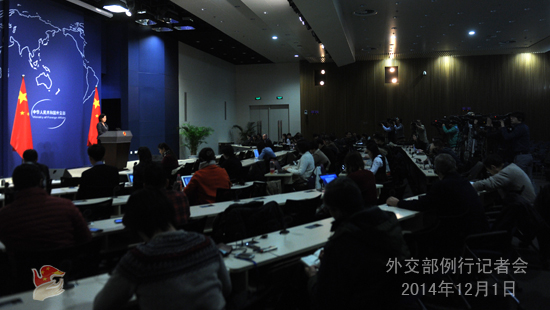
Q: The 20th Conference of the Parties (COP 20) of the United Nations Framework Convention on Climate Change (UNFCCC) is taking place in Lima, Peru. Please give us more details on China's attendance at the conference. What are China's expectations for this conference?
A: The COP 20 of the UNFCCC is being held in Lima, Peru from December 1 to 12. The Chinese government sent a delegation comprising the National Development and Reform Commission (NDRC), the Ministry of Foreign Affairs, the Ministry of Technology, the Ministry of Finance, the Ministry of Environmental Protection and representatives from governments of Hong Kong and Macao Special Administrative Regions. The delegation is headed by Xie Zhenhua, Vice Chairman of the NDRC with Vice Foreign Minister Liu Zhenmin as the first deputy head.
A "Chinese Corner" is set up in the Lima Conference, where a series of side events will be held by China's local governments, scientific research institutions, media, companies and non-governmental organizations to showcase China's policies, actions and outcomes in proactively addressing climate change in an all-round way.
The Lima Conference is an important station on the way towards reaching a new agreement on climate change in Paris, and will exert significant influence on the Paris Conference next year. China is ready to work with all parties proactively and constructively on the basis of openness and transparency, broad participation, negotiated consensus and party-driven mode, and strive for positive outcomes while upholding principles of "common but differentiated responsibilities", equity and respective capabilities.
To be more specific, the Chinese side believes that the Lima Conference should yield concrete results in the following aspects.
First, elements in the future draft agreement should be identified. This is the most crucial task to ensure that the agreement be reached on schedule, and also a priority in the Lima Conference. We hope that all parties can work hard to reach consensus on the elements. For those issues where consensus is hard to be forged for the time being, parties concerned should try their best to narrow differences through proper follow-up progress so that a negotiating text of the agreement could be produced in May, 2015 as defined by the Doha Conference.
Second, "contributions" should be specified. The Lima Conference should clarify requested information to parties when they submit the post-2020 "intended nationally determined contributions" (INDCs) in tackling climate change. All parties should positively explore a plan on contribution information that is acceptable to all.
Third, pre-2020 actions should be stepped up. The key is for developed countries to substantially increase their emission reduction before 2020, and fulfill their promises of supporting developing countries in capital and technology transfer as well as capacity building.