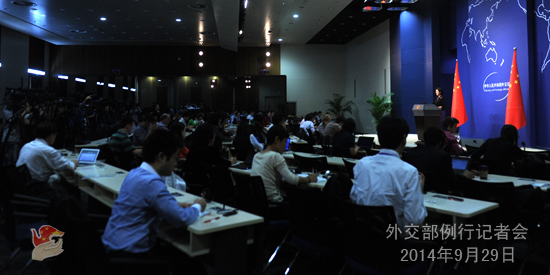
Q: A new round of negotiations for a comprehensive agreement on the Iranian nuclear issue has been held in New York the other day. What is China's comment on this?
A: From September 18 to 26, P5+1, the European Union and Iran held the 7th round of negotiations for a comprehensive agreement on the Iranian nuclear issue in New York. During this round, P5+1 and Iran held in-depth discussions on the core issues concerning the comprehensive agreement. Though substantive progress is yet to be achieved, all parties showed a sincere and pragmatic attitude as well as the political willingness to reach a comprehensive agreement at an early date.
The negotiation is currently at the final and crucial stage. China expects all parties to step up sense of urgency, press ahead with the negotiation, give full play to diplomatic wisdom and creativity on some thorny issues, take big steps and move towards the same goal. Just as Foreign Minister Wang Yi said in the general debate of the 69th United Nations General Assembly, all parties should display sincerity, act upon the spirit of mutual respect, equal-footed consultation and mutual accommodation, make further efforts on some difficult problems to achieve breakthroughs and seek a fair, balanced, mutual beneficial and win-win comprehensive agreement at an early date.
Q: Japanese Prime Minister Shinzo Abe said in today's address to the Diet that he hoped the meeting between Japanese and Chinese leaders would arrive as soon as possible and strategic and reciprocal relations with China would be proactively pressed ahead with. What is China's response to that?
A: We have elaborated multiple times on our principle and stance on relevant issues. China holds a clear and consistent position on improving and developing China-Japan relations. It is our belief that the sound and stable development of China-Japan relations is in the interests of the two countries as well as peace and stability of Asia. It is clear to all as for how the situation between China and Japan has come to what it is today. We hope that the Japanese side should take concrete actions and make favorable conditions for improving and developing bilateral relations.
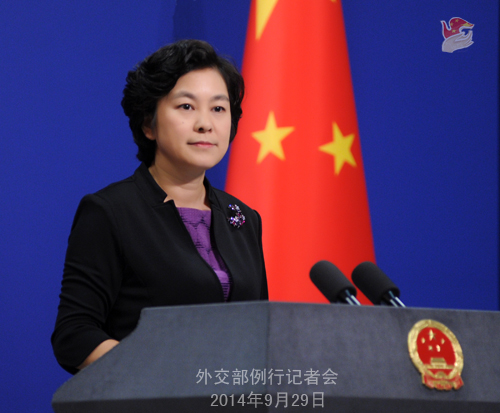
Q: The Japanese government recently approved an ordinance which delimits the outer continental shelf in parts of its seas. The ordinance will take effect on October 1. What is China's response to this?
A: We have taken note of the ordinance approved by Japan. On April 2012, the Commission on the Limits of the Continental Shelf (CLCS) set up in accordance with the United Nations Convention on the Law of Sea adopted a recommendation on the extension of Japan's continental shelf beyond the 200 nautical miles limit. The Japanese ordinance should respect the sanctity of the recommendation passed by the CLCS and shall not involve the international seafloor area which is a common inheritance of all human kind.
It is worth pointing out that the Okinotori Reef should not have exclusive economic zone and continental shelf, and the CLCS doesn't recognize the continental shelf zone extended outside the Okinotori Reef. Any case involving the extension of continental shelf and relevant domestic laws proposed by any country must abide by the rules of the international law.
Q: Can you comment on what role certain western countries play in stirring up the "Occupy Central" protest in Hong Kong? What's your comment on the US Consulate General in Hong Kong's remarks regarding the protest?
A: Since the morning of September 28, some people in the Hong Kong Special Administrative Region (SAR) illegally rallied and carried out the protest of "Occupy Central". The Spokesperson of the Hong Kong and Macao Affairs Office of the State Council has stated our principle and position, which is that the central government firmly opposes all kinds of illegal acts in Hong Kong that undermine the rule of law and sabotage social security and fully believes and strongly supports the lawful handling of the case by the Hong Kong SAR government.
We have noticed remarks made by certain countries. I'd like to reiterate that Hong Kong is China's Hong Kong, which is a special administrative region of China. Hong Kong affairs fully fall within China's domestic affairs. We hope that relevant countries can be prudent in their words and deeds, refrain from interfering in the internal affairs of Hong Kong in any way, stay away from supporting the illegal acts such as "Occupy Central", and do not send out wrong signals.
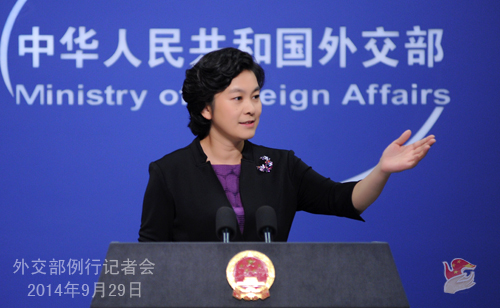
Q: In the past, the Chinese leaders usually lay wreath in the Tian'anmen Square on October 1, but this year the event is shifted to September 30. What are the considerations behind this?
A: The event on September 30 you mentioned is upon the decision made by the Standing Committee of the National People's Congress on designating this day as the Martyrs Memorial day and holding memorial activities for the purpose of carrying forward their spirit, memorizing their achievements, cultivating patriotism, collectivism and socialist morals of Chinese citizens, developing and implementing the core socialist values, enhancing the solidarity of the Chinese nation and stimulating the strong spiritual strength to realize the Chinese dream of great national renewal. This year on September 30, party and state leaders will lay flowers to the Monument of People's Heroes in the Tian'anmen Square.
Q: The University of Chicago said that it would suspend its relationship with the Confucius Institute. Is China concerned that this will affect its soft power push?
A: You may have noticed what President Xi Jinping said on the celebration of the 10th anniversary of the Confucius Institute: the Confucius Institute belongs to China, as well as the world. The purpose of setting up the Confucius Institute is to help people in other countries to learn Chinese, know more about the Chinese culture and enhance mutual understanding and friendship. The Confucius Institute serves as a bridge for China and the world to deepen mutual understanding and develop friendship.
Since 2004, with the close cooperation and concerted efforts of both China and the US, there are now 100 Confucius Institutes and 366 Confucius classrooms. 2.67 million American people have taken part in activities held by the Confucius Institutes which are warmly welcomed and widely applauded by all circles of America.
According to my knowledge, all Confucius Institutes in America are set up upon voluntary application of American universities on the basis of official agreement sealed through friendly negotiation among the headquarters of the Confucius Institute, Chinese universities and American universities. The Confucius Institutes provide American universities with teachers, teaching materials and other support upon voluntary application of the US side, never impose anything on others, and therefore are unlikely to threaten the academic freedom and integrity of universities.
We hope that through our joint efforts, the bridge of Confucius Institute can grow stronger and stay longer in increasing mutual understanding, communication and cooperation between Chinese people and people around the world including the Americans.