Premier Li Keqiang of the State Council will attend and address the opening ceremony of the Annual Meeting of the New Champions 2014 of the World Economic Forum, also known as the "Summer Davos" in Tianjin on September 10.
The Chinese government and the European Commission will host the 2nd meeting of China-EU High-level People-to-People Dialogue in Beijing on September 6. Vice Premier Liu Yandong of the State Council, Chair of the Chinese side, will co-host the meeting with Chair of the European side, European Commissioner Androulla Vassiliou for Education, Culture, Multilingualism and Youth.
Vice Premier Ma Kai of the State Council will travel to the UK to co-host the 6th China-UK Economic and Financial Dialogue with UK Chancellor of the Exchequer George Osborne, and to France to co-host the 2nd China-France High-Level Economic and Financial Dialogue with French Minister of Finance and Public Accounts Michel Sapin from September 10 to 16.
At the invitation of State Councilor Yang Jiechi, the US President's National Security Advisor Susan Rice will visit China from September 7 to 9. During her visit, both sides will exchange views on China-US relations and other important issues of common interest.
From now on, Ambassador Gong Xiaosheng will succeed Ambassador Wu Sike as China's Special Envoy on the Middle East Issue. Special Envoy Gong Xiaosheng is a senior diplomat who once served as Director of the Office of the People's Republic of China to the Palestinian National Authority (ambassadorial rank), Ambassador to Jordan and Ambassador to Turkey, and is very experienced in the Middle East affairs. We believe he will tap into his rich diplomatic experience, forge close and friendly relations with relevant parties, continue with the mediation efforts to advance peace talks, and make contributions to regional peace and stability.
Special Envoy Gong Xiaosheng will soon start his first foreign trip since assuming office to several countries in the Middle East region. He and relevant parties will have in-depth exchange of views on the current situation, and together push for an early, just and reasonable resolution of the Middle East issue.
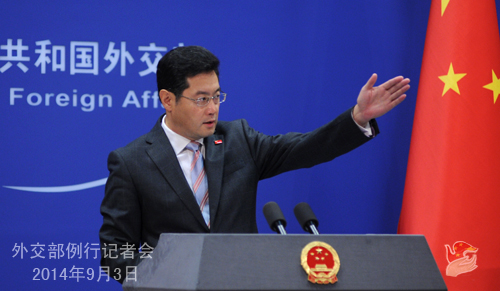
Q: Which countries will be covered in Special Envoy Gong Xiaosheng's first trip? What is China's view on the current Palestine-Israel situation? Will the Special Envoy put forward any new suggestions for the Palestine-Israel issue during his trip?
A: His first trip will bring him to Palestine, Israel, Egypt, Jordan and Lebanon. At present, China is in contact with relevant countries to arrange the trip.
You mentioned the Palestine-Israel situation. Not too long ago, Palestine and Israel reached the Gaza ceasefire deal. China welcomes that, and commends the mediation efforts made by Egypt and other relevant parties to make this happen. We believe the ceasefire deal represents an important step towards easing the current tense situation. We hope both Palestine and Israel can stick to the deal, safeguard the ceasefire, resume peace talks as soon as possible and push for an early, just and reasonable resolution of the Palestine-Israel issue.
Since this round of Palestine-Israel conflict broke out, China has been deeply concerned about the situation. We have been using various ways through multiple channels to promote peace talks. Not too long ago, Foreign Minister Wang Yi visited Egypt and the Headquarters of the Arab League, and put forward a five-point proposal for peacefully resolving the Palestine-Israel conflict. During his trip, Special Envoy Gong Xiaosheng will reach out to relevant countries and parties, and continue to promote peace talks.
Q: Japanese Prime Minister Shinzo Abe reshuffled his cabinet today. What is China's on comment on that? What is China's expectations for the new cabinet?
A: I have yet to see the namelist of Abe's new cabinet. The reshuffle of the cabinet falls within Japan's internal affairs. We will not make comments on that, but we hope Abe's cabinet members can work to promote and safeguard the improvement and development of China-Japan relations.
Q: Will President Xi Jinping attend the upcoming UN General Assembly?
A: As to who will attend the UN General Assembly which will soon be held at the UN Headquarters, relevant information will be released in due course.
Q: First, there are reports that China has asked the British side to drop their inquiry into Hong Kong's constitutional reform, but the British MPs refused such a request. What is China's comment on this? Second, senior officials from China and Canada held a meeting last week. Did they discuss the case involving two Canadian citizens accused of espionage and detained in China?
A: On your first question, we have said many times that today's Hong Kong, as a Special Administrative Region (SAR) of the People's Republic of China, is not the one before 1997. We oppose interference from any external force in any form in the affairs of Hong Kong SAR which fall within China's internal affair. Our position on this is firm and clear.
The truth is that since Hong Kong returned to the motherland in 1997, the principles of "One Country, Two Systems", "Hong Kong people governing Hong Kong" and "a high degree of autonomy" have proved to be a great success, which is recognized by anyone without prejudice. Therefore, we hope the international community, including those MPs from the UK, can understand this fact objectively and impartially. At the same time, we suggest some people to be more realistic. Today's Hong Kong is no longer the one before 1997. Any attempts at making irresponsible and unfounded remarks at Hong Kong will lead nowhere.
On your second question, I want to point out that the two Canadian citizens involved in this case, namely Kevin Garratt and his wife, are under investigation by relevant Chinese departments on suspicion of stealing intelligence covering military, scientific research projects of national defense and other areas. During the investigation process, the case will be handled in accordance with the law by relevant Chinese departments.
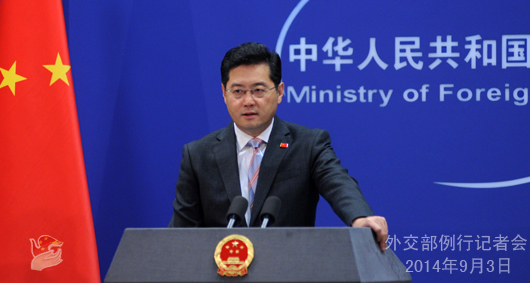
Q: Reports say that given the current unstable situation in Pakistan, China may adjust President Xi Jinping's plan to visit Pakistan in the near future. What is China's response to that?
A: China and Pakistan are in a very good relationship. We maintain close high-level exchanges. As for what the reports said about President Xi Jinping's visit to Pakistan, I have no information to offer. As a friendly neighbor to Pakistan, China is following the situation in Pakistan very closely. We hope that relevant parties in Pakistan can give priority to the fundamental interests of the state and the people, properly resolve relevant issues through consultation, dialogue and negotiation, and jointly safeguard national and social stability.
Q: The US State Department Spokesperson said on September 2 that America supports universal suffrage in Hong Kong, in accordance with the Basic Law. The US believes that an open society with the highest possible degree of autonomy and governed by rule of law is essential for Hong Kong's stability and prosperity. What is China comment?
A: I want to stress that in the light of the decision made by the Standing Committee of the National People's Congress of China on the selection of the Chief Executive of the Hong Kong SAR by universal suffrage, realizing the selection of the Chief Executive by universal suffrage is a historic step forward in the course of Hong Kong's democratic development. The central government's position on relevant issues has been made quite clear.
It is worth emphasizing once again that the selection of the Chief Executive of the Hong Kong SAR by universal suffrage has a bearing on Hong Kong's long-term prosperity and stability, as well as China's sovereignty, security and development interests, while ensuring Hong Kong's long-term prosperity and stability serves the common interests of the international community, including the US.
I also want to stress that Hong Kong's constitutional reform is China's internal affairs which brooks no interference from any external force. Therefore, we hope the international community can approach such a decision in an objective and positive light and contribute to the long-term prosperity and stability of Hong Kong.
Q: Commerce Ministers of China and India held a China-India Joint Economic Group meeting in Beijing on September 2. It was stated to be a key meeting ahead of President Xi Jinping's visit to India. What is China's comment on the meeting?
A: I would refer you to competent authorities for specifics of their meeting.
China and India are neighbors and partners for common development. Both countries are committed to realizing the dreams of national development and renewal. Considering the current international situation and the respective development of our two countries, China and India need to expand and deepen friendly cooperation in various fields, and such an aspiration is being shared by more and more people. We are willing to work with the Indian side to push for more fruitful results out of our mutually beneficial cooperation in economy and trade, investment, infrastructure and other fields, and bring greater benefits to the two countries and two peoples. When it comes to China-India cooperation, the more, the better.
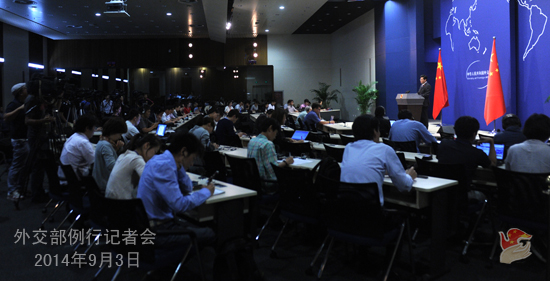
Q: The incoming EU High Representative for Foreign Affairs and Security Policy, Italian Foreign Minister Federica Mogherini said on September 2 that the EU will decide on further sanctions against Russia before September 5. What is China's comment on that?
A: I answered a relevant question the day before yesterday. I would like to reiterate that sanctions cannot resolve problems. If sanctions can serve that purpose, what is the point of mediation and political dialogue?
As the situation has reached this point, we hope relevant parties can calm down and do some serious thinking, figuring out what they should do and how to do it to fundamentally resolve the current Ukrainian crisis. China maintains that consultation and dialogue and political resolution is the only way out. Sanctions will only give rise to more uncertainties and more problems.
We hope relevant parties can do things that are conducive to the political resolution, refrain from fomenting disagreements and aggravating tension, and jointly safeguard peace, security and stability of the region, which serves the common interests of all parties.